

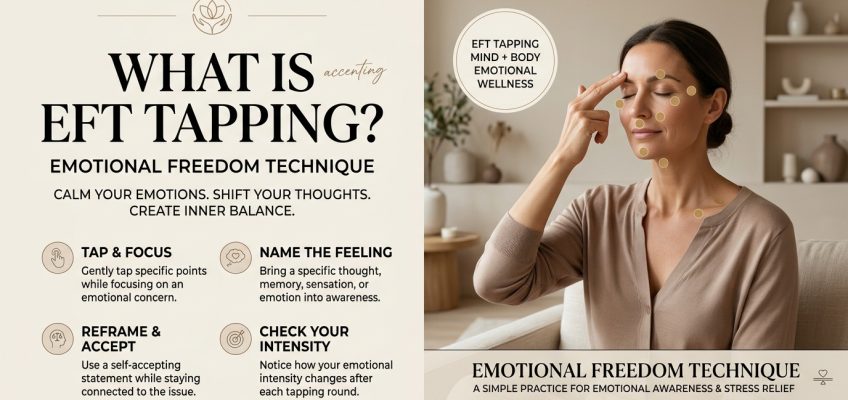
If you’ve spent any time in wellness circles lately, you’ve probably seen someone tapping on their face and collarbone while muttering a sentence out loud, and wondered what on earth they were doing. That’s Emotional Freedom Technique, or EFT — usually just called “tapping” — and despite how unusual it looks from the outside, it’s become one of the more researched alternative approaches in the emotional wellness space. It’s not magic, and it’s not for every problem, but it’s also not nothing. Let’s get into what it actually is, where it came from, and how it works.
Table of Contents
- What Is Emotional Freedom Technique (EFT)?
- How Does EFT Tapping Work?
- What Are the EFT Tapping Points?
- What Happens During an EFT Tapping Session?
- What Are the Potential Benefits of EFT?
- Can EFT Help With Stress and Anxiety?
- How to Practice EFT Tapping as a Beginner
- EFT vs. Traditional Therapy: What’s the Difference?
- What Does Research Say About EFT?
- Frequently Asked Questions About EFT
- Conclusion
What Is Emotional Freedom Technique (EFT)?
Emotional Freedom Technique, often written as Emotional Freedom Techniques or shortened to EFT, is a self-help method that combines physical tapping on specific points on the body with spoken statements about a problem you’re trying to work through. The idea is to reduce the emotional charge of a stressful memory, belief, or feeling by stimulating acupressure points while simultaneously directing your attention to the issue at hand.
EFT was developed in the early 1990s by Gary Craig, a Stanford-trained engineer who had studied under psychologist Dr. Roger Callahan. Callahan had developed an earlier method called Thought Field Therapy (TFT), which used specific tapping sequences — different ones for different problems — to relieve psychological distress. Craig noticed that clients often improved even when the exact sequence wasn’t followed to the letter, so he simplified the entire approach into a single generalized routine that could be used for almost any emotional issue, without needing a practitioner to diagnose which points to target. He called it Emotional Freedom Techniques.
What’s sometimes called “Clinical EFT” today refers to the more standardized, manualized version of the technique used in research and clinical settings. Clinical EFT combines three main ingredients: exposure (bringing a specific memory or feeling to mind), cognitive reframing (pairing the issue with a statement of self-acceptance), and acupressure (tapping on a defined set of points). This blend is part of why EFT sits at an interesting intersection — it borrows directly from well-established therapies like Cognitive Behavioral Therapy (CBT) and exposure therapy, while adding a body-based, energy psychology component drawn from acupuncture theory.
How Does EFT Tapping Work?
The basic mechanism behind EFT tapping is fairly straightforward once you break it down into steps. You bring a specific issue to mind — a stressful memory, a recurring worry, a physical sensation of anxiety — and rate how intense it feels, usually on a scale of 0 to 10. This is often called the Subjective Units of Distress Scale, or SUDS.
You then say a “setup statement” out loud while tapping on the side of your hand. The classic phrasing goes something like: “Even though I have this [problem], I deeply and completely accept myself.” This single sentence is doing two jobs at once — the first half is the exposure piece, naming the issue directly instead of avoiding it, and the second half is the cognitive reframe, pairing that discomfort with self-acceptance rather than self-judgment.
From there, you move through a sequence of tapping points on the face and upper body, repeating a shortened reminder phrase at each point to keep your attention on the issue. After a full round, you pause, take a breath, and re-rate your distress level. Many people notice their number drops after just one or two rounds — sometimes significantly. If it hasn’t dropped to a comfortable level, you simply repeat the process, often refining the language to get more specific about what’s actually bothering you.
The theory behind why this works is still debated. Proponents point to the acupuncture meridian system, suggesting that tapping on these points calms the body’s stress response and interrupts the fight-or-flight cycle. Skeptics point out that the exposure and cognitive reframing elements alone — borrowed from long-established, well-validated therapies — could account for most of the effect, with the tapping itself acting more like a focusing ritual than an active ingredient. Either way, a growing number of controlled studies have found that tapping on the actual acupoints produces better outcomes than tapping on “sham” or random points, which suggests the physical component isn’t purely incidental.
What Are the EFT Tapping Points?
One of the reasons EFT has spread so widely as a self-help tool is that the tapping points are easy to learn and don’t require any special equipment. A typical EFT round moves through the following points, usually tapped gently with two fingertips, five to seven times each:
- Karate Chop point — the fleshy outer edge of the hand, used during the setup statement
- Top of the head — the crown
- Eyebrow — the inner edge, just above the bridge of the nose
- Side of the eye — on the bone at the outer corner of the eye
- Under the eye — on the bone beneath the pupil
- Under the nose — between the nose and upper lip
- Chin point — the crease between the lower lip and chin
- Collarbone — just below where the collarbones meet
- Under the arm — roughly four inches below the armpit
These points roughly correspond to acupuncture meridian endpoints used in traditional Chinese medicine, which is part of why EFT is often grouped under the broader label of “energy psychology” alongside other tapping-based approaches. You don’t need to press hard — a light, consistent tap is enough to stimulate the point while you stay focused on the reminder phrase.
What Happens During an EFT Tapping Session?
A typical EFT session, whether self-guided or with a trained EFT practitioner, tends to follow a fairly consistent shape:
- Identify the target issue. This could be a specific memory, a general feeling like anxiety before a meeting, or a physical sensation of tension.
- Rate the intensity. Assign it a number from 0 to 10 before you start, so you have something concrete to compare against afterward.
- Set up the round. Say your setup statement while tapping the karate chop point, naming the issue plainly rather than softening it.
- Tap through the sequence. Move through each point with a short reminder phrase, keeping your attention on the feeling rather than distracting yourself from it.
- Reassess. Take a breath, check back in with your body, and re-rate the intensity.
- Repeat and refine. If the number hasn’t dropped enough, do another round, often getting more specific about the emotion underneath the original issue — anger might reveal grief underneath, for example, once the first layer eases.
A single session might involve several rounds targeting different angles of the same core issue. With a trained practitioner, sessions often go deeper into underlying beliefs or past events connected to the current distress, similar to how a therapist might trace a present-day trigger back to its origin — though EFT practitioners typically aren’t licensed mental health clinicians unless they hold that credential separately.
What Are the Potential Benefits of EFT?
Research into Clinical EFT has expanded considerably over the past two decades, and the findings point toward a handful of consistent benefits:
- Reduced anxiety symptoms, including generalized anxiety and performance-related anxiety
- Lower self-reported stress, often measured alongside physiological markers like cortisol
- Improvement in depressive symptoms in several controlled trials
- Reduced PTSD symptoms, with some reviews finding EFT among the more effective options studied for trauma-related distress
- Support with specific phobias, food cravings, and chronic pain in smaller bodies of research
It’s worth being clear-eyed here: EFT is not a replacement for treating diagnosed medical or psychiatric conditions, and researchers themselves are careful to describe it as an emerging or promising evidence-based practice rather than a cure-all. But for everyday emotional regulation — the kind of low-grade stress, racing thoughts, or emotional triggers most people deal with regularly — it’s a low-cost, low-risk tool that a fair number of people find genuinely useful.
Can EFT Help With Stress and Anxiety?
This is where most of the research attention has gone, and it’s also where most people encounter EFT for the first time — as a stress-relief or anxiety-management tool rather than a full therapeutic protocol. The appeal is fairly obvious: it takes a few minutes, requires nothing but your hands, and can be done privately before a stressful meeting, during a panic spiral, or as part of a nightly wind-down routine.
Several controlled trials have compared EFT tapping to other stress-reduction techniques, like diaphragmatic breathing or general relaxation exercises, and found tapping performs at least as well, and in some studies better, at lowering both subjective stress ratings and physiological stress markers. That doesn’t mean it works identically for everyone — like most mind-body techniques, results vary based on how consistently it’s practiced and how specific the language used during tapping actually is. Vague statements like “I feel stressed” tend to be less effective than pinpointing the exact sensation, thought, or memory driving the stress in that moment.
How to Practice EFT Tapping as a Beginner
If you want to try EFT tapping on your own, you don’t need a certification or special training to get started with the basics. A few practical tips make the difference between a technique that feels awkward and one that actually produces results:
- Get specific. Instead of “I’m anxious,” try naming exactly what’s happening — “I feel a tight knot in my chest thinking about tomorrow’s presentation.”
- Say it out loud, even if it feels silly. The exposure piece works better when you’re not just thinking the words but actually voicing them.
- Don’t rush the reassessment step. The number-rating habit keeps you honest about whether it’s actually working, rather than just going through the motions.
- Let the target shift. It’s common for one emotion to reveal another underneath it after a round or two — frustration giving way to disappointment, for instance. Follow where your attention actually goes.
- Be patient with the process. Some issues shift in a single round. Others, especially ones tied to longstanding patterns or old memories, take repeated sessions over time.
If you’re the kind of person who’s drawn to mind-body and belief-focused tools like EFT, it often pairs naturally with other approaches to transformational coaching, which works with a similar premise — that lasting change requires addressing the emotional and belief layer underneath a problem, not just the surface behavior.
EFT vs. Traditional Therapy: What’s the Difference?
It’s easy to lump EFT in with traditional talk therapy since both deal with emotional distress, but the two are meaningfully different in scope, training, and depth.
Traditional therapy, delivered by a licensed clinician, is equipped to diagnose and treat mental health conditions, work through complex trauma over an extended period, and provide the kind of sustained clinical relationship that serious psychological conditions often require.
EFT is typically shorter in format, doesn’t require a license to practice at a basic level, and is generally used either as a self-help tool or as a complementary technique alongside other forms of treatment — including therapy itself. Many licensed therapists have actually trained in Clinical EFT and use it as one tool within a broader treatment plan, rather than as a standalone replacement for talk therapy.
If you’re dealing with a diagnosed condition, complex trauma, or persistent symptoms that aren’t improving, EFT is best treated as a supplement to professional care rather than a substitute for it. For everyday emotional regulation, stress, and working through limiting beliefs, it can stand on its own perfectly well as a self-help practice — similar in spirit to how mindset-focused tools are used in coach certification training, where practitioners learn structured techniques for helping clients shift unhelpful patterns without stepping into clinical treatment territory.
What Does Research Say About EFT?
EFT has accumulated a surprisingly large research base for what started as a self-help technique. More than one hundred outcome studies, including dozens of randomized controlled trials, have examined Clinical EFT across a range of psychological and physiological conditions. According to a peer-reviewed systematic review published in Frontiers in Psychology, Clinical EFT has been evaluated against the American Psychological Association’s Division 12 criteria for empirically supported treatments, with researchers reporting measurable improvements in anxiety, depression, and stress-related symptoms, along with biological changes in markers like cortisol and gene expression.
A separate meta-analysis focused specifically on PTSD found that tapping on the actual acupuncture points produced better outcomes than tapping on sham or unrelated points, which researchers point to as evidence that the acupressure component isn’t purely a placebo effect layered on top of standard exposure and cognitive techniques. Other research reviewed in a study on EFT for stress and burnout among healthcare workers found rapid reductions in self-reported stress after brief tapping sessions, which is part of why the technique has found traction in high-stress professional settings, not just wellness or self-help circles.
That said, EFT is still not formally listed as an APA-endorsed evidence-based treatment in the way CBT or EMDR are, even though it has cleared several of the methodological bars researchers use to evaluate treatments. The honest summary is that the research is genuinely promising and expanding quickly, but the scientific community hasn’t fully settled the debate over exactly why tapping works — whether the acupoint stimulation itself is doing real physiological work, or whether it’s primarily a delivery mechanism for exposure and cognitive reframing that would work through other channels too.
Frequently Asked Questions About EFT
What is Emotional Freedom Technique used for?
EFT is most commonly used for stress, anxiety, emotional triggers, limiting beliefs, and processing difficult memories or emotions. Some practitioners also use it for physical concerns like chronic pain, sleep issues, and food cravings, though the research base for physical applications is generally thinner than for psychological ones.
How does EFT tapping actually work?
EFT combines exposure (naming a specific issue directly), cognitive reframing (pairing that issue with a statement of self-acceptance), and acupressure (tapping on defined points on the face and body). The combination appears to lower the emotional intensity of the target issue, often within a few rounds of tapping.
Is EFT tapping backed by science?
Yes, to a meaningful degree. More than one hundred clinical studies, including numerous randomized controlled trials, have examined Clinical EFT’s effects on anxiety, depression, PTSD, and stress. It hasn’t yet been formally classified as an APA evidence-based treatment the way some older therapies have, but the research base is substantial and growing.
Can I practice EFT tapping on my own?
Yes. The basic tapping sequence and setup statement are simple enough to learn and use independently, which is part of why EFT has spread so widely as a self-help tool. For deeper trauma or diagnosed mental health conditions, working with a trained EFT practitioner or licensed therapist is generally recommended.
How long does it take to see results from EFT tapping?
Many people notice a reduction in distress within a single session, sometimes after just one or two rounds of tapping. More deeply rooted issues, especially those tied to longstanding beliefs or past trauma, typically require repeated sessions over time to see lasting change.
Is EFT the same as acupuncture?
No, though they’re related. Acupuncture uses needles inserted into meridian points, while EFT uses fingertip tapping on a subset of those same points, combined with spoken statements. EFT is sometimes described as “acupuncture without needles,” but it’s a distinct technique with its own protocol.
What’s the difference between EFT and Thought Field Therapy (TFT)?
TFT came first and uses different, more complex tapping sequences depending on the specific issue being treated, typically requiring a trained practitioner to determine the correct algorithm. EFT, developed by Gary Craig after training under TFT founder Dr. Roger Callahan, simplified this into a single generalized sequence that can be applied to nearly any issue without specialized diagnosis.
Conclusion
Emotional Freedom Technique occupies an interesting space in the wellness world — simple enough to learn from a five-minute video, yet backed by a genuinely substantial and growing body of clinical research. Whether you’re drawn to it as a quick stress-relief tool or as part of a broader practice of working through limiting beliefs and emotional patterns, it’s worth approaching with the same mix of curiosity and honesty that any good self-help tool deserves: try it, pay attention to whether it actually moves the needle for you, and use it alongside professional support rather than instead of it when the issue calls for more than a few rounds of tapping.
If working with beliefs, emotions, and mindset patterns is something you want to explore more deeply — whether for yourself or as a path toward helping others — you can start with a free introductory training to get a feel for the kind of structured techniques used in this space.